







Dina Hadad – Vice Chair of K-Peritia
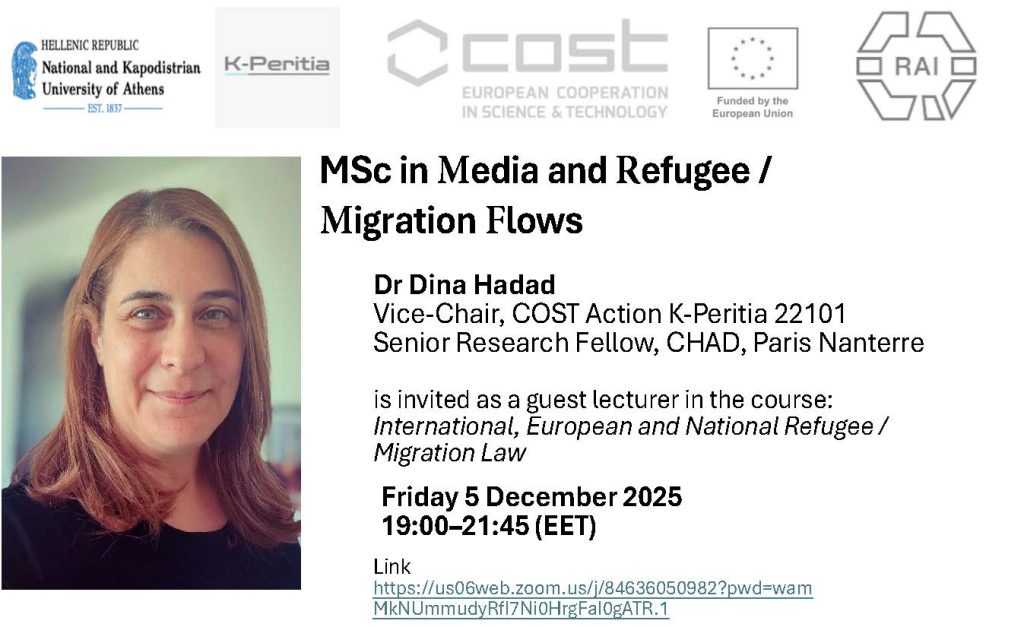
Reimagining Refugee Decision-Making Across Jurisdictions Through Cultural Expertise: Notes from My Guest Lecture at Athens University’s MSc in Media and Refugee? Migration Flows
In December 2025, I had the pleasure of delivering a guest lecture for the MSc in Media, Refugee and Migration Studies at Athens University in the course of International, European and National Migration Law an inspiring program that brings together students from across the world who are committed to understanding the complexities of media, displacement, refugee flows, and global mobility.
As Vice Chair of the EU-funded COST Action K-Peritia and a specialist in international law and human rights, I introduced cultural expertise as an essential yet latently deployed tool in decision-making processes concerning refugees, migrants, and vulnerable groups. The exchange drew more than twenty students with backgrounds in humanitarian work, advocacy, media analysis, and academic research. Their engagement affirmed the growing interest in integrating cultural expertise from indigenous knowledge to structured analytical reports into legal and institutional frameworks that shape refugee protection.
Introducing Cultural Expertise: Why It Matters
I explored cultural expertise as a practical methodology that supports courts, administrative bodies, and humanitarian actors in understanding cultural nuances. We discussed: the evolution of cultural expertise as a formalized concept, indigenous and local knowledge as critical forms of expertise. Case studies were introduced illustrating cultural expert reports in refugee, asylum, and migration contexts and within various jurisdictions. It was pertinent through all of that mentioned to highlight the role of cultural expertise in reducing misinterpretations, bias, and procedural injustice
Students expressed particular interest in how cultural expertise can inform credibility assessments, contextualize applicant narratives, and guide judges, lawyers, and caseworkers through unfamiliar cultural terrains.
The reception of the concept and its application was genuinely inspiring. Some participants described cultural expertise as a “missing piece” in refugee decision-making one that opens the way for a more humane, informed, and equitable approach.
What Students Told Us: Survey Insights
To better understand the impact of the lecture and identify learning needs, an interactive pedagogy sought feedback via Slido and Google Forms. Although the dataset was small, the insights were rich and remarkably consistent.
Key Takeaways from Participants included;
Cultural expertise is recognised as essential, participants saw the value of concept and its application, especially in asylum and refugee contexts, yet feel they lack structured resources, frameworks, or guidelines to use cultural expertise effectively. Reflecting a strong appetite for accessible, practitioner-focused resources, participants sought practical tools and were keen to know about available; Handbooks, context sheets for origin countries, clear guidance on professional application and different jurisdictional takes.
Field experiences evidently show cultural gaps impact outcomes. Students with experience in asylum interviews, reception centers, or advocacy described situations where cultural nuances were essential. Some noted that cultural expertise could have strengthened advocacy efforts or improved decision-making and showed interest in the timeline related to each of the concept and it application within different jurisdictions as per the case studies illuminating different aspects of applications, case studies were the most impactful part of the lecture. Real-world examples of cultural expert reports helped students understand how cultural expertise works in practice and why it matters.
There was a clear desire for continued professional development. Participants expressed interest in: understanding engagement with cultural experts and explored options of training and pools of available experts. The field is perceived as evolving and participants want to be part of that evolution. Participants’ backgrounds ranging from the refugee program to academic research underscore the multidimensional nature of cultural work in migration settings.
Looking Ahead
This lecture was more than a pedagogical teaching moment it was a shared conversation about how cultural expertise can reshape the way institutions interact with displaced and vulnerable communities. Students’ reflections show a clear awareness that cultural expertise is not an accessory; rather a foundational to fair, informed, and humane decision-making that seeks establishing a critical frame of justice based on fundamental human rights.
I remain grateful for the thoughtful engagement of the students and the opportunity to introduce this growing field to future practitioners and scholars. Their interest reinforces the importance of continuing to develop robust frameworks, training, and research that bring cultural expertise to the heart of refugee and migration governance.
This output is based upon work from K-Peritia CA22101, supported by COST (European Cooperation in Science and Technology).